




How to Choose a Vacuum Bag Press System for Veneering and Laminating
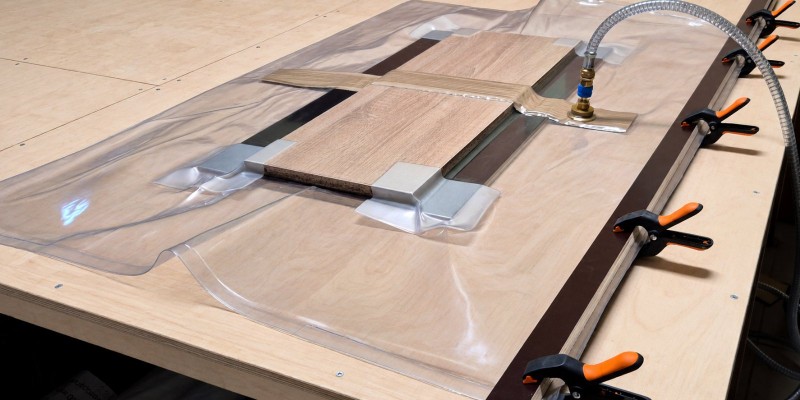
What a vacuum system is and what it consists of
- Vacuum station. This is the pump and everything that keeps it working properly: automatic control, filter, vacuum gauge, check valve and hose connections. Our stations come with all of these built in.
- What you need to add: a PVC bag, a vacuum bag adapter, quick-release couplings and a hose.
Choose the station by its capacity: 4 m³/h for a single bag and flat work, and 8 m³/h for large bags, bent laminations or several bags. All our stations reach a vacuum of −0.85 bar, which corresponds to a clamping pressure of about 8.5 tonnes per square metre.
Vacuum bag pressing is the simplest and most reliable way to get even clamping pressure over the whole surface of a panel or a curved part. You put the workpiece in the bag, pump out the air, and the atmosphere does the rest.
Atmospheric pressure is surprisingly strong. At a vacuum of −0.85 bar, the atmosphere presses the workpiece with about 0.85 kgf/cm², or 8.5 t/m². A 1200 × 2000 mm panel receives more than 20 tonnes, distributed perfectly evenly. No set of clamps can match that.
The best way to choose a system is to think of it as one whole, not as a pile of separate parts.
What a vacuum pressing system needs
A vacuum system needs the following components to work reliably:
- Vacuum pump to remove the air.
- Control system – controls the vacuum pump and holds the required vacuum while the glue cures.
- Filter – keeps wood dust out of the pump and extends its service life.
- Vacuum gauge – shows the current vacuum level.
- Check valve – prevents vacuum loss while the pump is idle.
- Quick-release couplings – for easy and fast connection.
You can buy them separately and assemble them yourself, but then you have to choose compatible components, put them together and test that they work. A vacuum station combines all of this in one ready-to-use unit.
Our vacuum stations already include all the necessary equipment
Every station comes with:
- An oil-free rotary vane pump from Becker, so there is no oil, no oil mist and no extra maintenance costs.
- Automatic start/stop control of the pump based on the Festo VPEV vacuum switch (VP-4 is the manually controlled version).
- A built-in filter to protect the pump from dust.
- A vacuum gauge on the front panel.
- A check valve – to protect the vacuum.
- Quick-release couplings.
- On the VS-4.8 and VS-8.8 models, a built-in 7.5-litre receiver.
All you need to add is a bag, an adapter with quick-release couplings and a hose. They are described below.
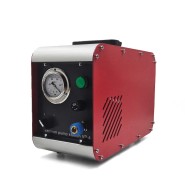
- Model: VP-4
- Control type: Manual (hand valve)
- Pump type: Oil-free
- Pump model: Becker VT 4.4
- Pump capacity: 4 m3/h
- Maximum vacuum: −0.85 bar
- Motor type: Single-phase
- Power: 0.18 kW
- Voltage: 240 V, 50 Hz
- Enclosure: 2 mm steel
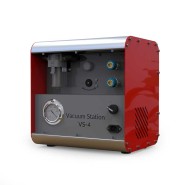
- Model: VS-4
- Control type: Automatic (Start/Stop)
- Control device: Festo VPEV
- Pump type: Oil-free
- Pump model: Becker VT 4.4
- Pump capacity: 4 m3/h
- Maximum vacuum: −0.85 bar
- Motor type: Single-phase
- Power: 0.18 kW
- Voltage: 240 V, 50 Hz
- Enclosure: 2 mm steel
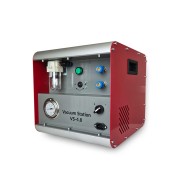
- Model: VS-4.8
- Control type: Fully automatic (Start/Stop)
- Control device: Festo VPEV
- Pump type: Oil-free
- Pump model: Becker VT 4.4
- Pump capacity: 4 m3/h
- Maximum vacuum: −0.85 bar
- Motor type: Single-phase
- Power: 0.18 kW
- Voltage: 240 V, 50 Hz
- Enclosure: 2 mm steel
- Tank capacity: 7.5 L
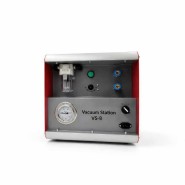
- Model: VS-8
- Control type: Automatic (Start/Stop)
- Control device: Festo VPEV
- Pump type: Oil-free
- Pump model: Becker VT 4.8
- Pump capacity: 8 m3/h
- Maximum vacuum: −0.85 bar
- Motor type: Single-phase
- Power: 0.35 kW
- Voltage: 240 V, 50 Hz
- Enclosure: 2 mm steel
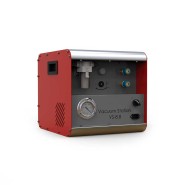
- Model: VS-8.8
- Control type: Fully automatic (Start/Stop)
- Control device: Festo VPEV
- Pump type: Oil-free
- Pump model: Becker VT 4.8
- Pump capacity: 8 m3/h
- Maximum vacuum: −0.85 bar
- Motor type: Single-phase
- Power: 0.35 kW
- Voltage: 240 V, 50 Hz
- Enclosure: 2 mm steel
- Tank capacity: 7.5 L
Choose the station by pump capacity
All our stations reach the same vacuum level, −0.85 bar, which is more than enough for most veneering, laminating and wood bending work. The difference between the models is the pump capacity, that is, how fast it removes the air.
| Station | Pump | Capacity | Motor power | Control type | Receiver | Vacuum ports |
|---|---|---|---|---|---|---|
| VP-4 | Becker VT 4.4 | 4 m³/h | 0.18 kW | Manual | – | 1 |
| VS-4 | Becker VT 4.4 | 4 m³/h | 0.18 kW | Automatic | – | 2 |
| VS-4.8 | Becker VT 4.4 | 4 m³/h | 0.18 kW | Automatic | 7.5 l | 2 |
| VS-8 | Becker VT 4.8 | 8 m³/h | 0.35 kW | Automatic | – | 2 |
| VS-8.8 | Becker VT 4.8 | 8 m³/h | 0.35 kW | Automatic | 7.5 l | 2 |
Which station is best for which job?
Use this as a starting point:
| Your job | Starting point |
|---|---|
| Occasional use, one bag | 4 m³/h (VP-4) |
| Regular use, one bag | 4 m³/h (VS-4 or VS-4.8) |
| Large bags, regular use | 8 m³/h (VS-8 or VS-8.8) |
| Curved parts, several bags on one station | 8 m³/h (VS-8.8) |
A pump with higher capacity evacuates a larger volume of air from the bag faster. But the end result will be the same, both with porous materials such as MDF and with materials that let little air through. Motor power on its own says little: all these stations use small motors (0.18–0.35 kW).
What the receiver is for
The stations (VS-4.8, VS-8.8) have a built-in receiver. Its main job is to create a small vacuum reserve, so that the control system works smoothly and small leaks are compensated.
Without a receiver, small leaks in the bag make the pump start and stop very often, which wears out the pump and the control switch. The receiver adds a vacuum buffer, so the level changes more slowly. The pump runs less, without frequent restarts, and the vacuum stays more stable.
If you plan to use large bags or several bags, choose a model with a receiver.
But you can also choose a system without a receiver (VS-4, VS-8) and connect it to your own external receiver.
What you need to add: bag, adapter and hose

- Thickness: 0.5 mm
- Width: 1370 mm.
- Inside width: 1340 mm.
- Length: 3200 mm
- Material: PVC
- Area of application: Veneer pressing, wood bending.
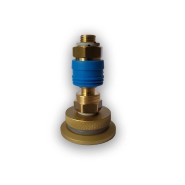
- D50-40-1/4: 1 set.
- KD/KS4: 1 set.
- Thread: 1/4
- Material: Anodized aluminum
- Area of application: Vinyl, PU and silicone vacuum bags.
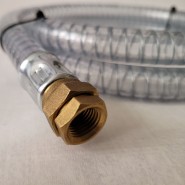
- Material: PVC
- Inner dia (ID): 12mm.
- Outer dia (OD): 18mm (1/2).
- Operating pressure range: -0.85-7 bar.
- Connection thread: G1/4 F.
- Area of application: Vinyl, PU vacuum bags and other vacuum application.
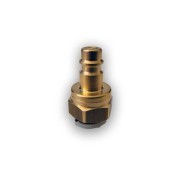
- Nominal dia: 8mm.
- Operating pressure range: -0.95-12 bar.
- Thread: G1/4.
- Nominal flow rate: 765 l/min.
- Area of application: Vinyl, PU vacuum bags and other vacuum application.
Vacuum bag
Our bags are made of PVC material 0.5 mm thick, with high-frequency welded seams. The bags are available in 35 sizes. Sizes range from 200 × 1500 mm for narrow parts to 1370 × 6200 mm for large panels, and extra-wide 1830 mm bags are also available. We can also make a bag to your dimensions.
What to consider when choosing a bag
- Bag size. Keep in mind that the inside width of the bag is smaller than the outside width. Bags 1370 mm wide have an inside width of 1340 mm, and bags 1830 mm wide – 1780 mm. Choose a size with some margin so that the workpiece fits inside freely and the bag closes without tension.
- Consider the thickness and height of the workpiece. A thick panel or a tall curved form needs more margin – choose a wider and longer bag.
- Working temperature. The PVC bag is designed for vacuum pressing at room temperature. If you use a heat-activated glue, this bag is not suitable.
Vacuum bag adapter
The adapter is the connection point between the bag and the hose. The adapter consists of two parts with seals and is installed through the bag wall. Our D50-40 adapters are made of anodised aluminium and come in several versions and kits:
| Adapter | Connection | Price excl. VAT |
|---|---|---|
| D50-40-1/4 | Female thread G1/4 | 27.00€ |
| D50-40-3/8 | Male thread G3/8 | 25.00€ |
| D50-40-10 | Hose barb for 10 mm hose | 28.00€ |
| Kit D50-40-1/4 + KD4/KS4 | D50-40-1/4, G1/4 with quick-release coupling | 48.00€ |
Quick-release coupling – a convenient solution for changing bags and hoses quickly. In a second you can disconnect the hose from one bag and connect it to the next. This is very convenient when you work with several bags or when a bag is under vacuum. The KD4 and KS4 couplings are also sold separately: KD4 socket 17.50€, KS4 plug 8.50€, set 24.50€. The couplings have built-in shut-off valves that prevent vacuum loss on both sides when disconnected.
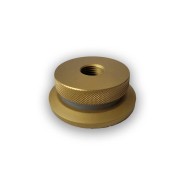
- Up part dia: 40 mm.
- Down parts dia: 50mm.
- Thread: G1/4
- Material: Anodized aluminum
- Area of application: Vinyl, PU and silicone vacuum bags.
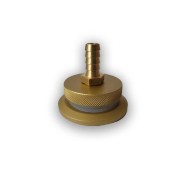
- Up part dia: 40 mm.
- Down parts dia: 50mm.
- Barb: 10mm
- Material: Anodized aluminum
- Area of application: Vinyl, PU and silicone vacuum bags.
- D50-40-1/4: 1 set.
- KD/KS4: 1 set.
- Thread: 1/4
- Material: Anodized aluminum
- Area of application: Vinyl, PU and silicone vacuum bags.
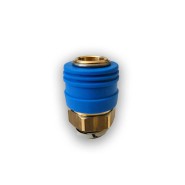
- Nominal dia: 8mm.
- Operating pressure range: -0.95-12 bar.
- Thread: G1/4.
- Nominal flow rate: 765 l/min.
- Area of application: Vinyl, PU vacuum bags and other vacuum application.
- Nominal dia: 8mm.
- Operating pressure range: -0.95-12 bar.
- Thread: G1/4.
- Nominal flow rate: 765 l/min.
- Area of application: Vinyl, PU vacuum bags and other vacuum application.
Hoses
Our hoses are made of reinforced PVC with a steel spiral, have an inside diameter of 12 mm and are designed for operation from −0.85 to 7 bar. They are supplied in lengths of 1.5 m, 3 m and 5 m with crimped female-thread connections G1/4, G3/8 or G1/2.
- Choose a length that suits the layout of your workshop. In practice, hose length has no significant effect on the vacuum level in the bag.
- Quick-release couplings screw directly into the hose thread, so no extra fittings are needed.
- Keep the hoses in good condition. The reinforcement stops the hose from collapsing under vacuum, but a hose that has been cut, crushed or kinked can cause leaks.
Vacuum gauge on the bag
For woodworking, a separate gauge on the bag is usually not needed. The gauge on the station shows the vacuum level, and that is enough for everyday work.
A separate gauge mounted directly on the bag is mainly needed when working with composite materials, where the process requires monitoring the vacuum inside the bag itself. For this we offer the M535RL-D50-40-1/4 kit (45.00€).
Keeping the system in working order
- Check the filter regularly. In a dusty workshop it clogs quickly.
- Watch how often the pump switches on. On stations with start/stop control, frequent pump starts during the process usually indicate a vacuum leak.
- How to find leaks: check the system step by step, starting from the vacuum source.
- Station. Disconnect the hose and make sure the station holds vacuum. If the vacuum drops, check that the filter bowl is fitted correctly: after cleaning the filter, the gasket is sometimes put back incorrectly. Also check the couplings (sockets) – dirt can get into their shut-off valves.
- Hose. Connect the hose to the station and check it. If there are no leaks, go to the next step.
- Adapter. Check how the adapter is installed, whether the seals are over-tightened and whether the connection is assembled correctly.
- Bag. Make sure the bag is sealed tightly and has no punctures or damaged seams.
Need help choosing?
And tell us:
- What you want to press: flat panels or curved parts, the materials and the type of glue.
- What bag size you need, or the size of your largest workpiece.
- How often you plan to use the system, and how many bags at once.
We will suggest a station, bag, adapter and hose – a complete set that works together.