




Veneer Pressing with a Vacuum Press: A Complete Beginner's Guide
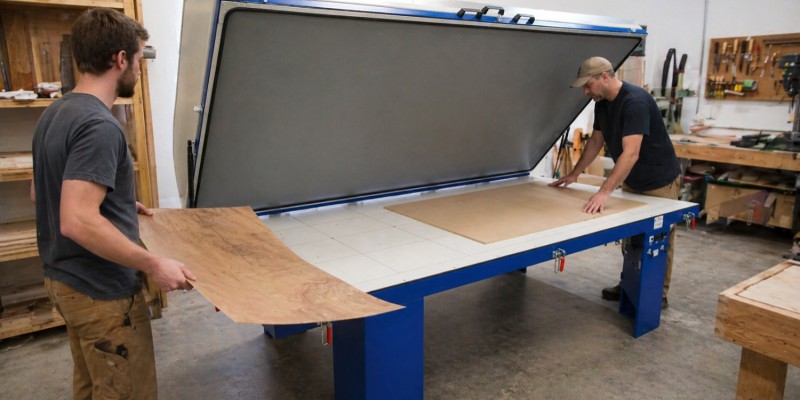
Veneer pressing is one of the most effective ways to create high-quality wooden surfaces for furniture, cabinet doors, panels, tabletops, decorative parts, and interior elements. Instead of using thick solid wood, a thin sheet of natural veneer is bonded to a stable substrate such as MDF, plywood, particleboard, or blockboard. The result is a beautiful real-wood surface with better dimensional stability and more efficient material use.
For beginners, veneer pressing may seem complicated at first. You need the right veneer, the right substrate, the right adhesive, and even pressure across the whole surface. This is where a vacuum press becomes extremely useful. A vacuum press applies uniform atmospheric pressure over the workpiece, helping the veneer bond evenly to the panel without the need for heavy mechanical clamps or large hydraulic presses.
This guide explains the basics of veneer pressing vacuum press work: how the process works, what materials are needed, how to prepare the veneer and substrate, how to avoid common mistakes, and how vacuum pressing can improve results in woodworking and furniture production.
What Is Veneer Pressing?
Veneer pressing is the process of bonding a thin sheet of wood veneer onto a base material. The base material is usually called the substrate or core. Common substrates include MDF, plywood, chipboard, HDF, and sometimes solid wood panels.
The veneer itself is usually very thin, often around 0.5–0.8 mm, although thicker veneers are also used in special applications. Because veneer is thin and flexible, it allows manufacturers and workshops to use valuable wood species more efficiently. Exotic, decorative, or premium wood species can be applied as a surface layer while the structural core remains stable and economical.
Veneer pressing is widely used for:
- furniture panels;
- cabinet doors;
- tables and desktops;
- wall panels;
- acoustic panels;
- doors and interior elements;
- decorative curved parts;
- custom joinery;
- yacht and vehicle interiors.
A good veneer pressing result should be flat, clean, well bonded, and free from bubbles, wrinkles, cracks, glue bleed-through, and surface defects.
Why Use a Vacuum Press for Veneer Pressing?
Traditional veneer pressing can be done with clamps, cauls, weights, screw presses, or hydraulic presses. These methods can work well, but they often require careful setup and may not apply pressure evenly over large or complex shapes.
A vacuum press solves many of these problems. When air is removed from a vacuum chamber, membrane press, or vacuum bag, atmospheric pressure presses the veneer evenly against the substrate. This creates uniform pressure across the surface, including corners and shaped areas.
Using a vacuum press for veneering offers several advantages:
- even pressure over the whole panel;
- suitable for large surfaces;
- good contact between veneer and substrate;
- fewer clamps and mechanical fixtures;
- useful for curved or shaped workpieces;
- repeatable results;
- efficient workflow for small and medium workshops;
- compatibility with vacuum bags and membrane presses.
For beginners, a vacuum press can make veneering more predictable because it reduces the risk of uneven clamp pressure. This is especially helpful when working with large panels, delicate veneer, or multiple parts at the same time.
Vacuum Press Veneer Woodworking: How the Process Works
The principle of vacuum press veneer woodworking is simple. Veneer, adhesive, and substrate are assembled into a “layup.” This layup is placed inside a vacuum bag or under a vacuum membrane. The air is removed, and atmospheric pressure presses everything together while the adhesive cures.
A basic veneer pressing cycle usually includes these steps:
- Prepare the substrate.
- Cut and prepare the veneer.
- Apply adhesive evenly.
- Assemble the veneer and substrate.
- Place the layup in the vacuum press or vacuum bag.
- Apply vacuum.
- Keep the workpiece under pressure for the required curing time.
- Remove the panel and allow it to stabilize.
- Trim, sand, and finish the surface.
Although the process looks simple, the quality depends on preparation. Clean surfaces, correct adhesive amount, balanced construction, and proper pressing time are essential.
Vacuum Bag Veneer Pressing vs. Membrane Vacuum Press
There are two common systems for vacuum veneering: vacuum bags and membrane vacuum presses.
Vacuum Bag Veneer Pressing
Vacuum bag veneer pressing uses a flexible bag, usually made from vinyl, polyurethane, silicone, or another vacuum-tight material. The prepared panel is placed inside the bag, the bag is sealed, and the pump removes air.
Vacuum bags are popular because they are affordable, flexible, and suitable for workshops that need a practical solution without a large machine. They are especially useful for:
- flat panels;
- small and medium furniture parts;
- curved molds;
- one-off projects;
- custom woodworking;
- educational workshops;
- prototype production.
The main advantage is flexibility. A vacuum bag can be used with different sizes and shapes, as long as the bag is large enough and properly sealed.
Membrane Vacuum Press
A membrane vacuum press uses a fixed press table and a flexible membrane mounted in a frame. The workpiece is placed on the table, the membrane is closed over it, and the pump removes air from the press chamber.
A membrane press is usually more convenient for regular production because it is faster to load and unload, easier to control, and more suitable for repeated cycles. It is commonly used by furniture manufacturers, cabinet makers, door producers, and workshops that process panels frequently.
A membrane press is ideal for:
- flat veneered panels;
- cabinet doors;
- shaped MDF doors;
- laminating;
- wood bending forms;
- repeated production cycles;
- larger workpieces.
Both systems can produce excellent results. The best choice depends on production volume, part size, budget, available space, and the type of work being done.
Choosing the Right Substrate
The substrate is the base material under the veneer. Choosing the correct substrate is important because veneer follows the surface and stability of the core.
Common substrates include:
- MDF: very smooth and stable, excellent for veneering and painted edges;
- plywood: strong and lightweight, good for furniture and structural parts;
- particleboard: economical and commonly used for furniture panels;
- HDF: dense and smooth, suitable for thin panels or special applications;
- solid wood: possible, but requires more care because it moves with humidity.
For beginners, MDF is often the easiest substrate for veneer pressing. It has a smooth surface, consistent density, and good dimensional stability. Plywood is also a strong option, but its surface quality must be checked carefully.
The substrate should be flat, dry, clean, and free from dust, grease, loose fibers, and surface damage. If the substrate is warped or uneven before pressing, the finished panel may also be imperfect.
Preparing the Veneer
Veneer preparation is one of the most important parts of the process.
Before pressing, inspect the veneer for cracks, splits, knots, holes, brittle areas, or irregular grain. Some natural veneer sheets are delicate and must be handled carefully. If the veneer is very dry or wavy, it may need conditioning or flattening before use.
Cut the veneer slightly larger than the substrate. This allows for trimming after pressing. A small overhang is important because veneer can shift slightly during assembly.
If several sheets are joined together, the seams must be straight and tight. Veneer tape or suitable joining methods can be used to hold sheets together before pressing. Poor seams may open during pressing or become visible after finishing.
For high-quality furniture work, pay attention to grain direction and visual matching. Book-matching, slip-matching, and sequence matching can create attractive decorative effects, but they require careful planning.
Adhesive Selection for Veneer Pressing
The adhesive must be suitable for veneer, substrate, press method, and working conditions. Different glues have different open times, curing times, water content, heat resistance, and final bond properties.
Common adhesives used in veneer pressing include:
- PVA woodworking glue;
- urea-formaldehyde resin glue;
- polyurethane adhesive;
- epoxy adhesive;
- contact adhesive for some special cases;
- heat-activated veneer adhesives.
For many beginner projects, PVA glue is easy to use and widely available. However, it may not always be the best choice for large panels, high-end veneering, or applications where creep resistance is important.
Urea-formaldehyde glue is often used in professional veneer work because it cures hard and has good resistance to creep. It can be suitable for flat panels and high-quality veneering, but it requires correct mixing, safe handling, and proper curing conditions.
Polyurethane and epoxy adhesives may be used for special materials, moisture resistance, or complex applications, but they require careful control.
The most important rule is to follow the adhesive manufacturer’s instructions for open time, spread rate, pressure, temperature, and curing time.
Applying Glue Correctly
Glue application has a major effect on veneer quality. Too little glue can cause poor bonding, dry spots, or bubbles. Too much glue can cause bleed-through, surface staining, long curing time, or veneer movement.
Apply the glue evenly across the substrate using a roller, spreader, notched tool, or another suitable applicator. The goal is a consistent thin layer without puddles or dry areas.
For thin veneer, glue bleed-through is a common risk. Porous veneers and open-grain woods can allow adhesive to come through the surface. This may affect staining and finishing later. Using the correct glue amount and choosing the right adhesive helps reduce this problem.
After applying glue, assemble the veneer and substrate within the adhesive open time. If the glue begins to dry before pressing, the bond may be weak.
Balanced Construction: Veneer Both Sides When Possible
One important beginner mistake is veneering only one side of a panel. When veneer and glue are applied to one side, the panel may absorb moisture unevenly and warp.
For stable results, it is often best to veneer both sides of the substrate. The back side does not always need the same decorative veneer. A balancing veneer or backing sheet can be used. The goal is to create similar tension and moisture movement on both sides.
Balanced construction is especially important for:
- large panels;
- thin substrates;
- cabinet doors;
- table tops;
- shelves;
- parts exposed to changing humidity.
If only one side is veneered, the risk of warping increases.
Using Cauls, Breather Fabric, and Protective Layers
Depending on the setup, additional layers may improve the result.
A caul is a flat board or plate placed over the veneer to distribute pressure and keep the surface flat. In vacuum pressing, cauls can be useful for flat panels, especially when very even pressure and surface quality are required.
Breather fabric or mesh helps air move inside a vacuum bag, allowing the pump to evacuate air evenly. Without proper airflow, trapped air pockets may remain in the bag.
Release film or protective sheets can prevent glue from sticking to the bag, membrane, or cauls. This is important because excess glue may squeeze out during pressing.
Typical layers may include:
- substrate;
- adhesive;
- veneer;
- release layer;
- caul or flexible protective layer;
- breather fabric, if needed;
- vacuum bag or membrane.
The exact stack depends on the press type, adhesive, and workpiece shape.
Setting the Vacuum Level
In veneer pressing, the vacuum level must be strong enough to create full contact between veneer and substrate. However, the system must also be safe for the materials and setup.
A high vacuum creates strong pressure, but the actual required level depends on the adhesive, panel size, substrate, and veneer type. For flat veneering, the goal is consistent contact and stable pressure during the curing time.
Make sure the vacuum bag or membrane is properly sealed. If the vacuum level drops during pressing, the adhesive bond may become inconsistent. A vacuum receiver and automatic start/stop control can help maintain stable pressure and reduce pump cycling.
Check the gauge during the cycle. A slow loss of vacuum may indicate a leak in the bag, seal, hose, fitting, or membrane.
Pressing Time and Curing
Pressing time depends mainly on the adhesive. Some glues set quickly, while others require longer clamping or pressing time. Temperature and humidity also affect curing.
Do not remove the panel too early. Even if the veneer seems attached, the bond may not have reached sufficient strength. Early removal can lead to bubbles, edge lifting, or panel movement.
After pressing, allow the panel to rest and stabilize before trimming, sanding, or machining. This is especially important for larger panels and water-based adhesives.
Follow the adhesive instructions carefully. Guessing the pressing time is one of the easiest ways to create problems.
Common Problems in Vacuum Veneer Pressing
Beginners often face a few common issues.
Bubbles
Bubbles may appear when there is insufficient glue, uneven pressure, trapped air, contamination, or early removal from the press. They can also occur if the veneer was wavy or not properly prepared.
Glue Bleed-Through
Glue bleed-through happens when adhesive comes through the veneer surface. It is more common with thin veneer, porous wood species, or too much glue. It may cause finishing problems later.
Wrinkles
Wrinkles can occur when veneer shifts during assembly or when it is too wavy, too wet, or not properly flattened before pressing.
Cracks and Splits
Cracks may happen if veneer is brittle, too dry, mishandled, or forced over a sharp curve without preparation.
Poor Edge Bonding
Edges may lift if glue is missing, pressure is weak, or the panel is removed from the press too soon.
Warping
Warping is often caused by unbalanced construction, uneven moisture, unstable substrate, or veneering only one side.
Beginner Tips for Better Results
Start with simple flat panels before moving to complex curves or expensive veneer. Use a stable substrate such as MDF and a veneer species that is not too brittle. Practice glue application on test pieces before pressing large panels.
Keep the work area clean. Dust, chips, and glue lumps can create defects under the veneer. Prepare all materials before applying glue so you are not rushing during the open time.
Use slightly oversized veneer and trim after pressing. Mark grain direction and panel orientation clearly. If using several veneer sheets, prepare seams carefully.
Check the vacuum system before pressing the final workpiece. A quick leak test can save the project. Make sure the bag, membrane, seals, hoses, and fittings are working correctly.
Do not overload the press with too many parts until you understand the process. Consistency is more important than speed when learning.
Wood Laminating Vacuum Applications
The same basic process is also used in wood laminating vacuum work. Instead of bonding a thin veneer to a flat substrate, vacuum pressure can be used to laminate multiple thin layers, bend wood over a form, or bond decorative materials to shaped surfaces.
Vacuum laminating is useful for:
- curved furniture parts;
- bent plywood;
- shaped panels;
- decorative wood layers;
- architectural elements;
- custom molds;
- laminated components.
When laminating curves, make sure the bending form is strong, smooth, and correctly shaped. The membrane or bag must be able to apply pressure without bridging over hollow areas. Flexible cauls, breather layers, and careful vacuum control may be needed.
Safety and Good Workshop Practice
Vacuum pressing is generally safe when equipment is used correctly, but good workshop habits are still important.
Use gloves when handling veneer, because thin sheets can cut like paper. Wear eye protection when trimming, sanding, or working with press equipment. Follow adhesive safety instructions, especially when mixing resin glues or working with chemicals.
Keep the vacuum pump clean and protected from dust and glue. Use filters when needed. Check that hoses are not damaged and that electrical components are in good condition.
Never place sharp objects inside a vacuum bag or under a membrane without protection. Sharp edges can damage the bag or membrane.
Final Checklist for Veneer Pressing with a Vacuum Press
Before pressing, confirm that:
- the substrate is flat, clean, and dry;
- the veneer is prepared and slightly oversized;
- seams are tight and properly taped if needed;
- the correct adhesive is ready;
- glue can be applied evenly;
- the vacuum bag or membrane is clean;
- breather fabric or protective layers are prepared;
- the vacuum system holds pressure;
- pressing time is known;
- the panel will be balanced if needed.
After pressing, check the surface for bubbles, wrinkles, edge lifting, and bonding quality. Let the panel stabilize before trimming and finishing.
Conclusion
Veneer pressing with a vacuum press is a practical and reliable method for creating high-quality veneered panels and laminated wood components. It allows even pressure across the surface, works well for many panel sizes, and is useful for both flat and shaped parts.
For beginners, the key to success is preparation. Choose a stable substrate, prepare the veneer carefully, apply the correct amount of adhesive, maintain stable vacuum, and allow enough curing time. Understanding these basics will help avoid common problems such as bubbles, glue bleed-through, wrinkles, and warping.
Whether you use a membrane press or a vacuum bag, veneer pressing vacuum press techniques can greatly improve the quality and consistency of woodworking projects. With practice, vacuum pressing becomes one of the most valuable methods for furniture making, cabinet production, custom joinery, and professional wood laminating work.