




What Is Shore Hardness and Why Does It Matter When Choosing a Vacuum Press Membrane?
Choosing the right membrane for a vacuum press is one of the key factors that affects product quality, process stability, and equipment lifespan. Among the various technical characteristics of a membrane, Shore hardness plays a particularly important role.
Manufacturers working with vacuum presses — in the furniture industry, MDF lamination, veneering, or composite forming — often focus on membrane thickness or its cost. However, membrane hardness directly affects its elasticity, pressure distribution, wear resistance, and ability to conform to complex part geometries.
Understanding the Shore hardness parameter helps manufacturers choose a membrane that will operate reliably and efficiently under real production conditions.
What Is Shore Hardness
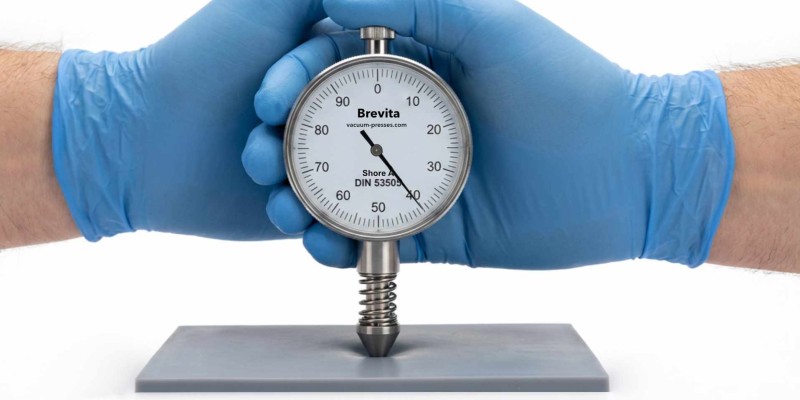
Shore hardness is a standardized method used to measure the hardness of elastomeric materials such as rubber, silicone, and other flexible polymers. This value indicates the material’s resistance to indentation under a specific force.
The measurement is performed using a special instrument called a durometer. Its indenter tip is pressed against the surface of the material with a defined force, and the depth of penetration determines the hardness value.
The measurement scale ranges from 0 to 100:
- Lower values indicate a softer and more elastic material
- Higher values indicate a harder and more rigid material
Shore A Scale and Membrane Materials
The Shore A scale is the most commonly used hardness measurement system for silicone and rubber materials.
For reference, several approximate material levels can be illustrated as follows:
| Shore A Value | Material Feel |
|---|---|
| 20–30 | Very soft rubber |
| 35–40 | Soft flexible membrane |
| 45–55 | Medium hardness elastomer |
| 60–70 | Relatively rigid rubber |
Most vacuum press membranes fall within the 40–60 Shore A range, where an optimal balance between flexibility and durability is achieved.
Both silicone membranes and natural rubber membranes can be manufactured within this hardness range.
Why Membrane Hardness Is Important for Vacuum Presses
Shore hardness determines how the membrane behaves during the operating cycle of the press.
During operation, the membrane must stretch, conform to the shape of the workpiece, and transfer pressure evenly across the entire surface. If the hardness is not properly selected, various production problems may occur.
The main parameters affected by membrane hardness include:
- membrane elasticity
- uniform pressure distribution
- ability to form complex shapes
- resistance to mechanical loads
- durability under cyclic operation
A properly selected hardness allows the membrane to operate consistently and significantly extends its service life.
Membrane Elasticity and Part Forming
One of the primary functions of a membrane in a vacuum press is to accurately conform to the shape of the workpiece.
Softer membranes — for example around 40 Shore A — provide greater elasticity and higher stretch capability.
This allows them to work effectively with:
- deep profiles
- radius furniture components
- decorative milling patterns
- complex three-dimensional shapes
Thanks to their high elasticity, such membranes press more tightly against the surface of the part, improving the quality of lamination or veneering.
However, softer membranes also have a drawback — they may wear faster and can be more sensitive to mechanical damage, especially under intensive production conditions.
Pressure Distribution and Surface Quality
Another important factor influenced by membrane hardness is the uniformity of pressure distribution.
A membrane that is too rigid may not conform well to complex surfaces. As a result, pressure may be distributed unevenly, which can lead to several defects:
- formation of air bubbles
- incomplete film bonding
- surface defects
- reduced adhesion quality
A membrane with the correct elasticity ensures that vacuum pressure is transferred evenly across the entire surface of the part.
This is especially important in:
- PVC film lamination
- veneering processes
- decorative furniture front production
- composite panel forming
The correct hardness ensures consistent quality of the finished product.
Wear Resistance and Mechanical Strength
While softer membranes provide better elasticity, harder membranes typically offer higher resistance to dynamic mechanical loads.
Membranes with hardness around 50–55 Shore A provide a good balance between elasticity and strength.
Such membranes are better able to withstand:
- a high number of pressing cycles
- friction against workpiece surfaces
- mechanical stress in the clamping area
- long-term industrial operation
In factories with continuous production, membrane durability becomes an especially important factor.
A membrane that is too soft may fail faster, resulting in additional maintenance costs and equipment downtime.
40 Shore vs 55 Shore Membrane: Key Differences
One of the most common questions when selecting a membrane is the comparison between 40 Shore and 55 Shore.
Although the numerical difference appears small, in practice the material properties differ significantly.
40 Shore A Membrane
Characteristics:
- high elasticity
- greater stretch capability
- excellent conformity to complex shapes
- good adaptation to deep profiles
Typical applications:
- MDF fronts with deep milling
- complex furniture elements
- veneering of radius parts
Possible limitations:
- lower wear resistance
- higher sensitivity to mechanical damage
55 Shore A Membrane
Characteristics:
- higher stiffness
- increased mechanical strength
- longer service life
- stable performance in industrial production
Typical applications:
- lamination of flat panels
- standard furniture components
- high-volume serial production
Possible limitations:
- lower elasticity
- less suitable for very deep profiles
In many cases, membranes in the 40–50 Shore A range are considered an excellent compromise, providing a good balance between elasticity and durability.
Hardness of Silicone vs Rubber Membranes
Both silicone and rubber membranes are used in vacuum presses, but their performance can differ even at the same hardness level.
Silicone membranes generally maintain their mechanical properties better at elevated temperatures.
This makes them particularly suitable for:
- hot lamination processes
- thermofoil applications
- long production cycles
Natural rubber membranes provide excellent elasticity and tear resistance. However, at higher temperatures their properties may change more significantly than those of silicone.
Therefore, when selecting a membrane, it is important to consider not only the hardness value but also the material type.
Other Parameters Related to Hardness
Although Shore hardness is an important characteristic, it should not be evaluated in isolation from other material properties.
Membrane performance is also influenced by:
- Elongation at break — the maximum stretching capability of the material
- Tensile strength — the maximum load the material can withstand under tension
- Tear resistance — the material’s resistance to crack propagation
- Temperature resistance — the material’s ability to withstand press operating temperatures
Together, these parameters determine the durability and overall efficiency of the membrane.
How to Choose the Right Membrane Hardness
The optimal membrane hardness depends primarily on production conditions and part geometry.
Soft membranes (30–40 Shore A)
Suitable for complex shapes, deep profiles, and decorative surfaces.
Medium hardness (40–50 Shore A)
A universal solution for most production applications.
Harder membranes (50–60 Shore A)
Optimal for flat panel lamination and intensive industrial use.
It is also important to consider:
- press operating temperature
- production volume
- materials and films used
- type of adhesive systems
In many cases, the most reliable way to choose the correct membrane is practical testing of membranes with different hardness levels under real production conditions.
Conclusion
Shore hardness is one of the key parameters when selecting a vacuum press membrane. It directly influences membrane elasticity, pressure distribution, resistance to mechanical loads, and overall service life.
Softer membranes provide better conformity to complex shapes, while harder membranes offer improved durability and wear resistance. The optimal choice depends on the type of production tasks and operating conditions.
Understanding how Shore hardness affects membrane behavior helps manufacturers choose between options such as 40 Shore A and 55 Shore A and ensure stable and efficient vacuum press operation.