




Vacuum Bag or Vacuum Press: Which System Should You Choose for Your Workshop?
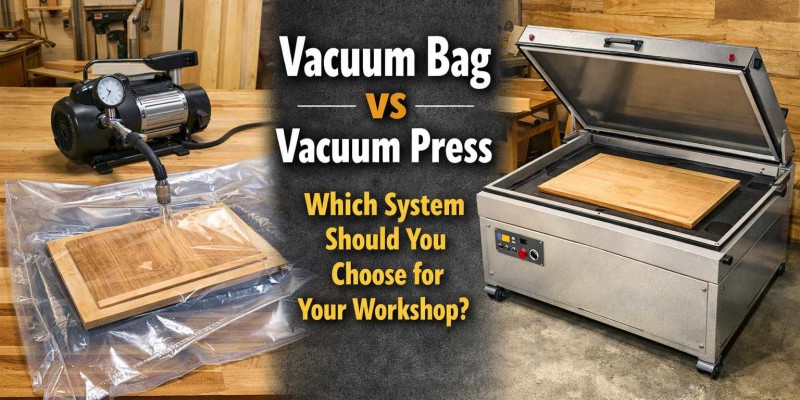
In modern woodworking, furniture manufacturing, and composite material processing, vacuum technologies have become one of the most effective methods for veneering, laminating, and forming parts.
When working with veneer, PVC films, HPL plastics, or composite materials, vacuum pressure provides uniform pressing across the entire surface without the need for a large number of mechanical clamps.
In practice, two main technologies are used:
- vacuum bags
- vacuum membrane presses
Both systems are based on the use of atmospheric pressure to evenly press materials together after air is removed from a sealed chamber.
How Vacuum Pressing Works
Vacuum pressing uses atmospheric pressure as a natural clamping force.
Atmospheric pressure at sea level is approximately 1 bar (100 kPa).
After air is removed from a sealed chamber, external atmospheric pressure begins to evenly press the materials together.
In practice, vacuum systems typically create a vacuum level of:
–0.8…–0.95 bar
This corresponds to a pressing force of:
8–9.5 tons per square meter of surface area.
Vacuum pressing is widely used for:
- veneer pressing
- HPL lamination
- forming curved furniture components
- processing composite materials
- manufacturing architectural panels
Vacuum Bag Diagram
Diagram of the vacuum pressing process using a vacuum bag.
What Is a Vacuum Bag
A vacuum bag is one of the simplest and most affordable methods of vacuum pressing.
In this system, the workpiece together with adhesive layers is placed inside a sealed flexible bag. After air is removed, atmospheric pressure evenly presses the materials together.
Vacuum bags are typically made from:
- PVC
- polyurethane
- rubber
- silicone
Advantages of Vacuum Bags
Low Equipment Cost
The cost of a vacuum bag system is significantly lower than that of an industrial vacuum press.
Application Flexibility
It can be used for parts of different sizes and shapes.
Compact Design
The system requires minimal space and is suitable even for small workshops.
Ideal for Curved Parts
The flexible bag easily follows the shape of complex molds.
Disadvantages of Vacuum Bags
- low productivity
- manual loading process
- risk of bag damage
- slower changeover between parts
Vacuum Membrane Press
A vacuum membrane press is industrial equipment designed for more stable and faster pressing.
The main component is an elastic membrane, typically made of silicone or natural rubber.
The membrane is mounted on a metal frame and forms a sealed chamber above the working table.
Vacuum Membrane Press Diagram
Operating principle of a vacuum membrane press.
Positive Pressure Membrane Press
In industrial production, membrane presses with additional positive pressure are widely used.
Such systems utilize:
- vacuum in the lower chamber
- positive pressure in the upper chamber
Typical parameters include:
- vacuum: -0.9 bar
- pressure: 4–6 bar
Pressure Comparison
Comparison of pressure in vacuum pressing systems.
Vacuum Bag vs Vacuum Press: Comparison
| Parameter | Vacuum Bag | Membrane Press |
|---|---|---|
| Cost | low | high |
| Productivity | low | high |
| Production type | custom / small batch | serial production |
| Automation | none | possible |
| Complex shapes | good | excellent |
How to Choose the Right System for Your Workshop
A Vacuum Bag Is Suitable If:
- you operate a small workshop
- you produce custom products
- your budget is limited
- flexibility is important
A Membrane Press Is Better If:
- you have serial furniture production
- you laminate PVC films
- you manufacture furniture fronts
- high productivity is required
Conclusion
Both vacuum bags and membrane presses are effective technologies for laminating and pressing materials.
Vacuum bags offer flexibility and low equipment cost, while membrane presses provide higher productivity and more consistent quality.
The choice between a vacuum bag and a vacuum press depends on production type, production volume, and available budget.